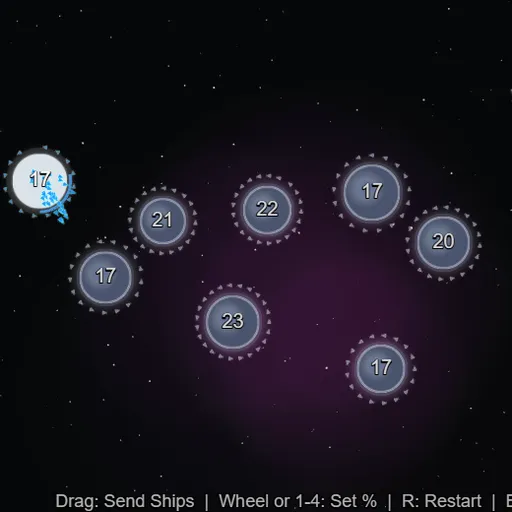
OrbitSwarm is a compact real-time strategy game where the whole battle fits on one screen of planets. You own a blue home world, a computer rival owns a red one, and gray neutral planets sit in between. Drag from your planet to another to send a stream of tiny ships, and every world you take starts building ships for you. It comes from Frank Force’s open-source LittleJS Arcade, and matches last only a few minutes.
Rules of the swarm
Choose EASY, MEDIUM or HARD. Each planet you own shows a number, its current ship count. Neutral planets show their defenders but do not grow until someone captures them.
Press on a planet you own, drag a line to a target and release. Half of the ships leave by default. Keys 1 to 4 change that share to 10, 25, 50 or 100 percent, and the mouse wheel does the same while dragging. Ships sent to your own planet reinforce it.
Bigger planets build faster and hold more ships. A ring shows how full each of your planets is, and a full planet stops producing. Take every red planet to win, and the game shows your time.
OrbitSwarm Controls
| Action | Keyboard | Mouse | Touch |
|---|---|---|---|
| Send a fleet | — | Press on your planet, drag to a target and release | Drag from your planet to a target |
| Set the share of ships sent | 1 = 10%, 2 = 25%, 3 = 50%, 4 = 100% | Scroll the wheel while dragging | — |
| Restart the match | R | — | — |
| Pause | Esc | — | — |
Estimation and growth
OrbitSwarm is a game of quick arithmetic. Before each send, you compare your ships against the defenders, then add what the target will build during the flight. Sending 12 ships at a planet with 12 defenders usually fails, because it will have 13 or 14 when they land.
It is also a lesson in compounding. A captured planet makes more ships, which capture more planets, which make even more ships. Early cheap captures matter because their production keeps adding up for the rest of the match.
Plans that work
- Take the closest small neutrals first. They cost few ships and start paying back at once.
- Overshoot a little. Add a margin of a few ships to cover production during the trip.
- Never let a planet sit full. Move extra ships forward so production never stops.
- Counterattack after the rival sends. It often launches half or more from one planet, which leaves that planet weak.
- Keep some ships at home. A 100 percent send leaves an empty planet that is easy to steal back.
Quiet by design
The game has no sound, and a restart with R is instant. For more space-themed planning, try the tower defense Elematter or the war-on-a-map game Compact Conflict.
Tested and updated: