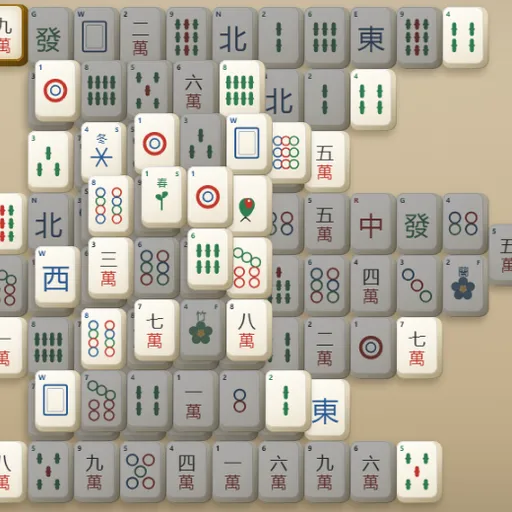
Mahjong Solitaire is a quiet tile-matching puzzle for one player. A full set of 144 mahjong tiles is piled into a layered shape, and you clear it by taking away matching pairs that are not blocked. Speed matters less than order, since one careless match can lock tiles you need later. This version of Mahjong Solitaire offers six layouts, and each deal is built so that at least one complete solution exists.
The basics
Pick a board from the menu and take a moment to look at it. A tile can be taken only if nothing is on top of it and its left or right side is clear. Blocked tiles are dimmed, so free ones stand out.
Click a free tile to select it, then click another free tile with the same face. Both disappear. Most tiles must match exactly. Flowers and seasons are the exceptions: any flower matches any flower, and any season matches any season. They carry a small F or S in the corner.
The tile set has three suits (circles, bamboo and characters), four winds, three dragons, four flowers and four seasons. If no free pairs remain, the game offers a shuffle that rebuilds the remaining tiles into a solvable layout.
Mahjong Solitaire Controls
| Action | Keyboard | Mouse | Touch |
|---|---|---|---|
| Pick up a tile, then take a matching pair | Tab into the board, arrows to move, Enter or Space to select | Click a free tile, then click its match | Tap a free tile, then tap its match |
| Put the selected tile back | Esc | Click the same tile again | — |
| Show a pair you can take | H | Click "Hint" | — |
| Undo the last pair | Z | Click "Undo" | — |
| Reshuffle the tiles still on the board | S | Click "Shuffle" | — |
| Start a new deal | N | Click "New game" | — |
Why it is good for your brain
Mahjong Solitaire is a visual search task. You scan dozens of tiles for an exact match, which trains attention to small details like the number of dots or the shape of a character.
It is also a planning game. Every face appears four times, so when three copies are free you must choose which two to take. The better choice is the pair that frees more tiles underneath or beside them. Thinking about what each move unlocks is the same kind of forward planning used in chess openings or route finding.
Smart play
- Open long rows from the ends, since middle tiles stay locked until a side is clear.
- Prioritize pairs that uncover tall stacks.
- When three or four copies of a face are free, pick the pair that opens the most.
- Keep an eye on the open pairs counter and slow down when it drops to one or two.
- Save flowers and seasons for tight spots, since any two of them match.
- Use hints sparingly. Each one costs points.
Layouts and extras
The six boards are Turtle, Terraces, Butterfly, Fortress, Pyramid and Spider, each marked by difficulty. You can replay the exact same deal after a win, switch between light and dark tables and turn sounds off. Full keyboard play is supported with arrow keys and single-letter shortcuts.
For another calm matching game, try Memory Pairs. If you prefer a card puzzle with clear rules and no hidden pieces, FreeCell Solitaire is a natural next step.
Tested and updated: