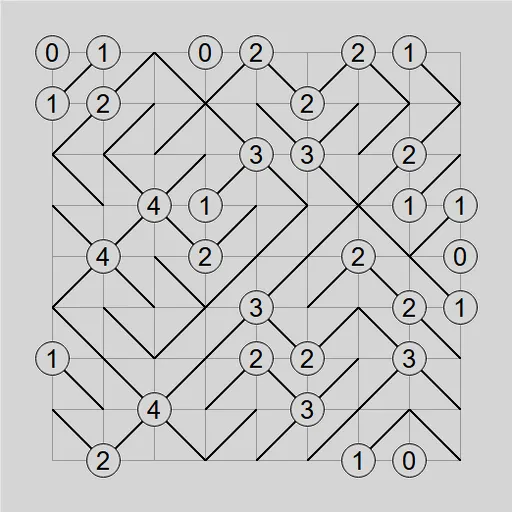
Slant Diagonals asks you to fill a grid with nothing but diagonal lines. Every square gets one line leaning left or right, and circled numbers on the grid corners say how many lines must touch each point. One more rule ties it together: the lines may never close into a loop. Slant Diagonals is Slant from Simon Tatham’s Portable Puzzle Collection, and two short rules give it surprisingly long chains of reasoning.
How the board works
Each square holds one diagonal. One kind runs from the top-left corner to the bottom-right, and the other runs from the top-right corner to the bottom-left. A finished board has no blank squares.
The circled clues sit on grid points. A clue counts how many of the squares around that point have their line touching it. Inner points touch four squares, border points touch two, and the grid’s own corners touch one.
Lines must never form a closed loop of any size. In a correct board, every chain of lines eventually runs out to the edge. Lines that close a loop, and clues that can no longer be met, show in a warning color.
Presets offer 5x5, 8x8 and 12x10 grids at Easy or Hard.
Slant Diagonals Controls
| Action | Keyboard | Mouse | Touch |
|---|---|---|---|
| Place or cycle a \ line | Arrow keys to move, then Enter | Left-click a square | Tap a square with Tap set to "\ first" |
| Place or cycle a / line | Space | Right-click a square | Press and hold, or set Tap to "/ first" and tap |
| Set a square to one direction directly / empty it | Type / or \ / Backspace | — | — |
| New game, undo, redo | N, U, R | Menu buttons above the grid | Menu buttons above the grid |
Why it is great logic practice
The clues are local, but the no-loop rule is global. You have to switch between counting lines at one point and picturing the whole web of lines across the board. Holding both views at once is a real mental workout.
It also builds proof-by-contradiction habits. Many steps go like this: if this square leaned left, it would finish a diamond, so it must lean right.
Tactics, step by step
- Settle 4s and border 0s first. They decide every square around them.
- Use the edges. A border clue touches two squares, so a 0 or 2 there fixes both lines. A grid-corner clue touches only one square.
- Recheck both ends. Each new line touches two points, and finishing one clue often forces its other squares to lean away.
- Spot three-sided diamonds. When three sides of a small diamond are drawn, the fourth square must lean the other way.
- Full clues push away. Once a clue has its count, every remaining square around it leans away from it.
- Swap the buttons in Preferences if the default slant order feels backward.
Small Details That Help
Hard puzzles ask you to reason about how pairs of squares relate, so try Easy first. Undo, redo and Solve are always available. For a puzzle that wants exactly one loop, try Loopy Loop Puzzle. For a two-color balance puzzle, try Unruly Black and White.
Tested and updated: