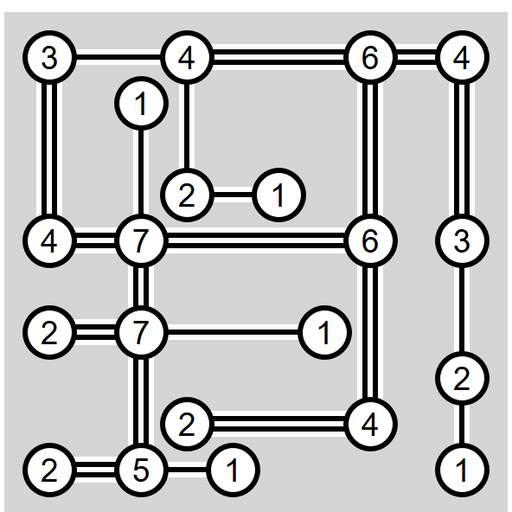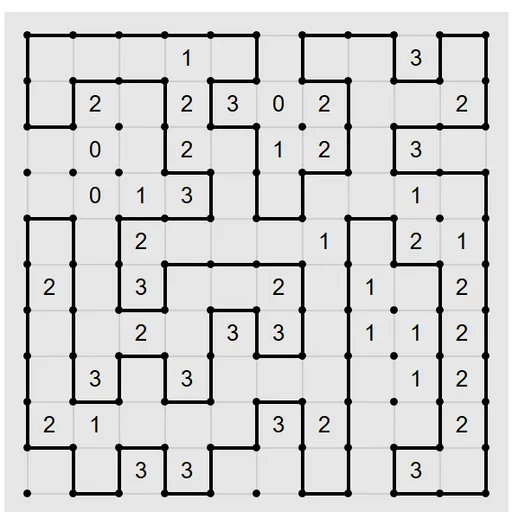
Loopy Loop Puzzle asks you to draw one closed loop through a field of dots. Numbers in the cells say how many of that cell’s sides the loop uses. On a square grid it is a tidy logic puzzle, but Loopy Loop Puzzle also runs on triangles, hexagons and even tilings that never repeat, which makes it one of the most varied puzzles on the site. Mike Pinna wrote it for Simon Tatham’s Portable Puzzle Collection, and Lambros Lambrou added the unusual grids.
How to draw the loop
Every possible line begins yellow, meaning undecided. Click a line to make it black and part of your loop. If you know a line is not used, rule it out and it fades. Click again to return it to yellow.
The finished drawing must be a single ring. It cannot cross itself, branch, or split into separate pieces. Each numbered cell must have exactly that many sides on the loop, while blank cells can have any number. The board flashes when you are right.
The default is a 10x10 square grid at Easy. Custom pairs any grid type with Easy, Normal, Tricky or Hard.
Loopy Loop Puzzle Controls
| Action | Keyboard | Mouse | Touch |
|---|---|---|---|
| Mark a line as part of the loop (click again to clear) | — | Left-click the line | Tap the line |
| Rule a line out (click again to clear) | — | Right-click the line | Press and hold the line |
| New game, undo, redo | N, U, R | Menu buttons above the grid | Menu buttons above the grid |
Where the math comes in
Loopy is graph theory in disguise. The dots are points and the lines are connections, and a valid answer is a single cycle. The key fact is simple: on a loop, every point has either zero or two lines touching it. Applying that rule at every dot, over and over, solves most of the puzzle.
Odd grid shapes stretch your spatial reasoning. A 3 on a hexagon means something different from a 3 on a square, so you have to rethink patterns instead of memorizing them.
Patterns that crack it open
- Zeros first. Rule out every side of each 0 straight away.
- Neighboring 3s. On a square grid, two side-by-side 3s always use the line between them and the two outer lines parallel to it.
- Check each dot. Two black lines at a dot means its other lines are out. One black line and one open line means the loop must continue along the open one.
- Beware small rings. Closing a little loop early is wrong unless it is the entire answer.
- Corner 3s. A 3 in a corner of a square grid uses both outside edges.
- Learn a new shape on Easy in Custom before you try it at Hard.
Small Details That Help
Undo is unlimited, and Restart and Solve are always available. For a loop puzzle with a different kind of clue, try Pearl Loop Puzzle. For a no-loops rule instead, try Slant Diagonals.
Tested and updated: