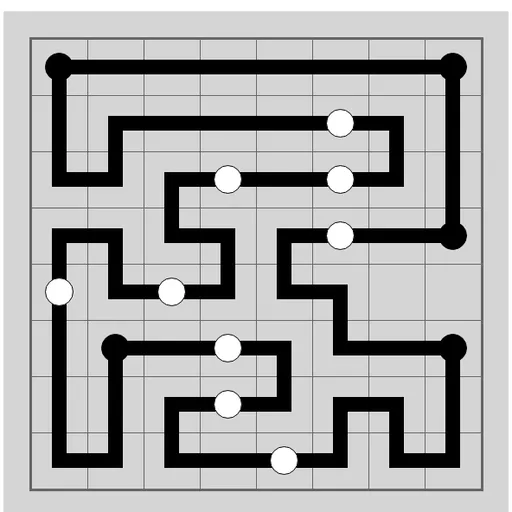
Pearl Loop Puzzle is about drawing one closed path through a grid while obeying the pearls placed on it. Black pearls force the path to turn, and white pearls force it to go straight. Those two short rules work together in surprising ways, and a few pearls are often enough to decide the whole loop. Simon Tatham built Pearl Loop Puzzle for his Portable Puzzle Collection, with help from James Harvey.
The rules of the path
The loop travels between the centers of squares that share a side. It may not cross itself or branch, and it must close as a single ring. Squares without pearls can be used or skipped.
- Black pearl: the loop turns a corner on it, and the squares on both sides of that corner, along the loop, must be straight.
- White pearl: the loop goes straight through it, and at least one of the squares beside it along the loop must be a corner.
When every pearl is happy and the path is one ring, the board flashes. Grids come in 6x6, 8x8, 10x10 and 12x8, each at Easy or Tricky, with 8x8 Tricky as the default.
Pearl Loop Puzzle Controls
| Action | Keyboard | Mouse | Touch |
|---|---|---|---|
| Draw or erase loop segments | Enter to start and end a keyboard drag, arrows to move | Left-click an edge, or left-drag through squares | Tap an edge, or drag through squares |
| Mark an edge with a cross | Shift + arrow | Right-click the edge | Press and hold the edge |
| Toggle the edge next to the cursor | Ctrl + Shift + arrow | — | — |
| Cancel a keyboard drag | Space, Escape or Backspace | — | — |
| New game, undo, redo | N, U, R | Menu buttons above the grid | Menu buttons above the grid |
Why the rules are so powerful
Each pearl rule reaches beyond its own square. A black pearl controls three squares in two directions, and a white pearl controls its neighbors too. Chasing those effects across the board trains you to think in chains: if this, then that, then that.
That style of reasoning is the same as following a proof step by step. You start with a fact, apply a rule, and get a new fact you can build on.
Moves the experts use
- Point border blacks inward. A black pearl on the edge, or one square away, cannot send an arm toward the edge, so that arm runs two squares inward instead.
- Three whites in a row cross. If three white pearls line up, the loop passes through each one at right angles to that line.
- Adjacent blacks push apart. Two black pearls side by side each send their arm away from the other.
- Cross out edges you rule out. Marks make the remaining choices clear.
- Close the loop last. An early small ring is always wrong unless it covers every pearl.
- Drag to sketch fast. Dragging through squares draws several segments, and dragging back erases them.
Things Worth Knowing First
On a phone, drag your finger to draw and press and hold an edge to cross it out. Easy boards suit a short break, and Tricky 12x8 boards can take a while. For more loop logic, try Loopy Loop Puzzle. For a path that must fill every square, try Number Path.
Tested and updated: