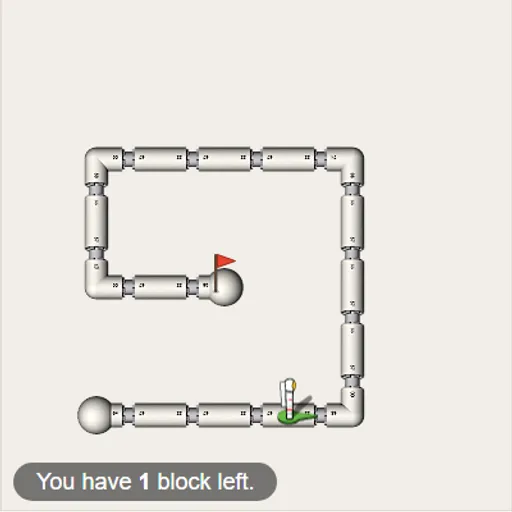
Block Code Maze is a no-typing introduction to programming. You drag colored blocks into a stack, press Run, and an astronaut walks a maze of white pipes exactly as your program says. Over ten levels Block Code Maze builds from a two-block sequence to a loop with a decision inside it, which is the same core logic used in real robot and game code.
What happens in each level
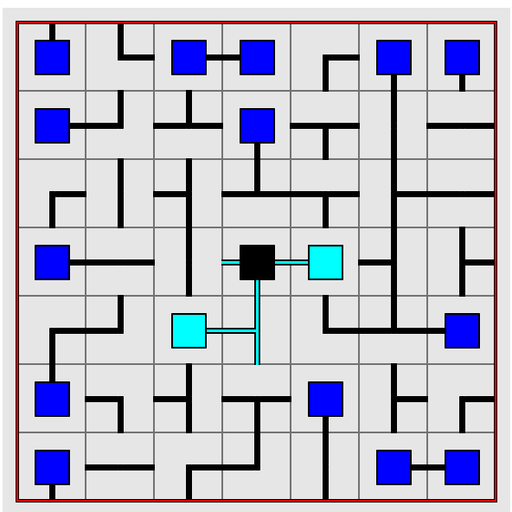
The maze sits on the left with the astronaut and a red goal flag. On the right are a gray toolbox and a white workspace. You pull blocks from the toolbox and snap them under each other. The top block runs first, then the next, and so on down the stack.
Press Run Program to watch. If the astronaut reaches the flag, a box pops up with the JavaScript your blocks turned into, and OK takes you to the next maze. If it walks into a wall, it spins and stops, and you press Reset to edit.
New blocks appear as you go. First you only have move forward and turn left or right. Then a repeat-until block lets one loop carry the astronaut all the way to the goal. After that, if-path and if-else blocks check whether a route is open ahead, to the left or to the right.
Block Code Maze Controls
| Action | Mouse | Touch |
|---|---|---|
| Add a block to your program | Drag it from the gray toolbox into the white workspace | Drag it with your finger |
| Join blocks | Drop a block just under or inside another until it clicks in place | Drop it under or inside another block |
| Remove a block | Drag it onto the trash can or back to the toolbox | Drag it onto the trash can |
| Change a direction in a block | Click the small drop-down arrow on the block | Tap the drop-down arrow |
| Run or stop the program | Click Run Program, then Reset | Tap Run Program, then Reset |
| Jump to another level | Click a dot or number at the top | Tap a dot or number |
What it teaches
The big idea is that a computer follows instructions in order, with no guessing. A missing turn is not “close enough”. That habit of exact, step-by-step thinking is the base of all programming.
The second idea is the loop. When a path repeats the same moves, you write them once and wrap them in repeat. The block limits make this feel natural, because the long version simply does not fit.
The last idea is the condition. An if block lets one small program handle mazes it has never seen. By the final level you are writing a simple wall-following algorithm, a real method for solving any maze where the walls are connected.
Ways to crack the harder mazes
- Count squares and turns aloud before building anything.
- Find the smallest chunk of moves that repeats, then loop only that chunk.
- If you run out of blocks, it means the level wants a loop or an if, not more steps.
- For the last mazes, try a rule like “move forward; if there is a path to the left, turn left”.
- Run often. Seeing where the astronaut stops tells you which block is wrong.
Small Details That Help
Finished levels are remembered in your browser, and you can jump between levels with the numbered dots at the top. The levels are short, so a few can fit into a spare ten minutes. When you are ready to add angles and art, move on to Block Code Turtle Art, or try planning a whole route without blocks in Robot Coder.
Tested and updated: