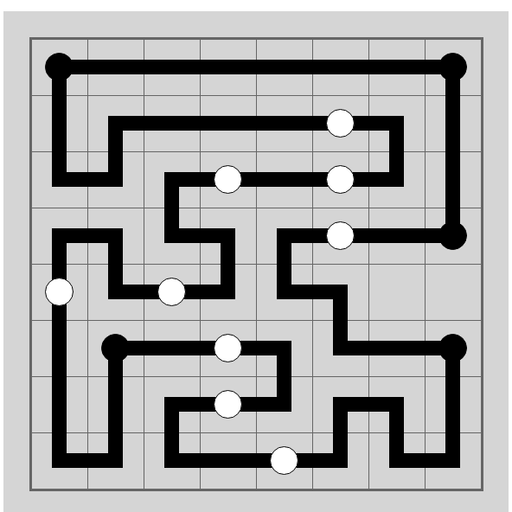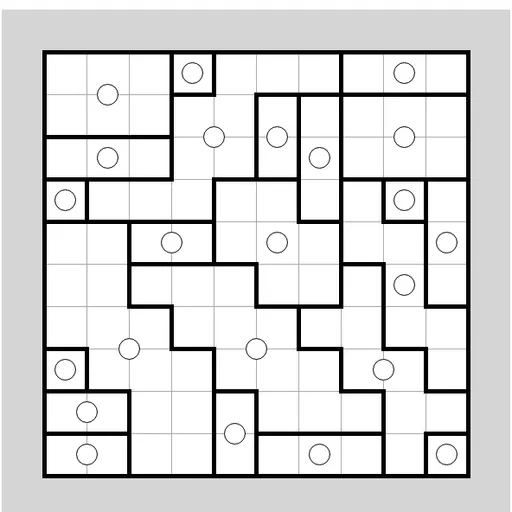
Galaxies Symmetry Puzzle fills a grid with small dots and asks you to split it into regions, one per dot. Each region must look exactly the same after a half turn around its own dot. You mark the answer by drawing walls along grid lines. This version was written by James Harvey for Simon Tatham’s Portable Puzzle Collection, and it is excellent practice for seeing rotational symmetry.
The Goal
Every square belongs to exactly one region, and every region holds one dot at its center of symmetry. Click a grid line to draw or erase a wall. A region is valid once it is fully closed, contains a single dot at its center, matches itself under a 180 degree turn and has no stray wall inside. Valid regions light up, so you can watch your progress.
The puzzle is finished when the walls are exactly the borders between regions. Boards come in 7x7, 10x10 and 15x15 at Normal or Unreasonable, and Custom lets you set your own size.
Galaxies Symmetry Puzzle Controls
| Action | Keyboard | Mouse | Touch |
|---|---|---|---|
| Draw or erase a wall on a grid line | Arrow keys to move, then Enter on a line | Left-click the line | Tap the line |
| Drag a reminder arrow out of a dot | Enter on a dot to pick up, Enter again to drop | Right-drag from the dot to a square | Press and hold the dot, then drag |
| Move or delete an arrow | — | Right-drag it elsewhere, or off the grid | Press and hold it, then drag |
| New game, undo, redo | N, U, R | Menu buttons above the grid | Menu buttons above the grid |
Symmetry as a Tool
Rotating a shape 180 degrees around a point sends each square to the square directly opposite, the same distance away. That is the same idea as point reflection in coordinate geometry: the point (x, y) maps to (2a − x, 2b − y) when the center is (a, b). Every time you claim a square for a dot, you claim its mirror too.
This makes the puzzle less about guessing shapes and more about pairs. Claim one square and you have placed two.
Solving Habits
- Mirror as you go. Every square you assign gets its opposite partner at once.
- Separate close dots. Two dots in neighboring squares need a wall between those squares.
- Fill forced corners. A square only one dot can reach with a valid mirror belongs to that dot.
- Use arrows as notes for squares you have assigned but not yet walled.
- Check unlit regions. If a closed shape does not glow, look for an inner wall or a broken mirror.
Things Worth Knowing First
A 7x7 Normal board is a short session, while 15x15 boards suit a longer sit. On phones, tap lines to draw walls and press and hold a dot to drag arrows; turning the phone sideways helps on big boards. Next, try Tangram for more shape geometry, or Range Shading Puzzle for grid logic.
Tested and updated: