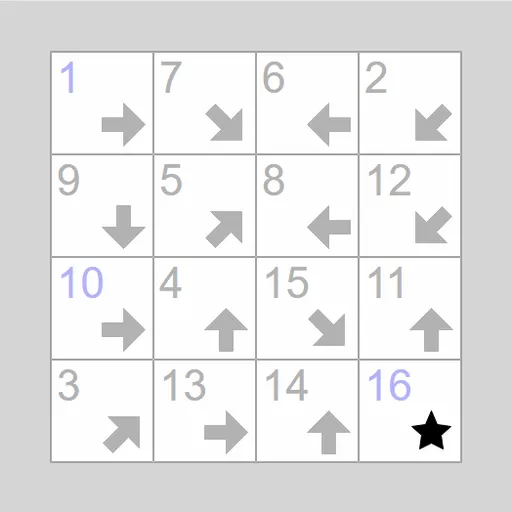
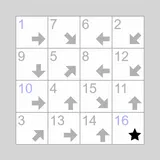
Signpost Arrow Chain is a sequence puzzle where every square is a signpost. Each holds an arrow, and a few show numbers. You link all the squares into one chain from 1 to the last number, with each arrow pointing along a line toward the square that comes next. It is Signpost, by James Harvey, from Simon Tatham’s Portable Puzzle Collection. It is worth playing for the way it trains careful forward and backward reasoning.
How Linking Works
A 4x4 board has 16 squares, so the chain runs 1 to 16. The first and last numbers are always shown, and the last square has a star instead of an arrow. Some boards reveal a few numbers between.
Drag from a square to its successor to link them. The successor can be any distance away along the arrow’s line, straight or diagonal. Right-drag to link a square to its predecessor instead. Pressing on a square highlights every legal target, which saves a lot of guessing. When a chain reaches a numbered square, all of its squares get numbers.
Signpost Arrow Chain Controls
| Action | Keyboard | Mouse | Touch |
|---|---|---|---|
| Link a square to the one that comes next | Arrow keys to move, Enter on the first square, Enter again on the next | Left-drag from a square to its successor | Drag from a square to its successor |
| Link a square to the one that comes before it | Space on a square, then Space again on its predecessor | Right-drag from a square to its predecessor | Press and hold, then drag (or set Tap to Link backward) |
| Break the links of one square | — | Left-drag the square off the grid | Drag the square off the grid |
| Break a whole chain | — | Right-drag any square of the chain off the grid | Press and hold, then drag off the grid |
| New game, undo, redo | N, U, R | Menu buttons above the grid | Menu buttons above the grid |
What It Teaches
This is a puzzle about order and direction. Each arrow is a constraint saying “the next number lies somewhere on this ray”. Solving means finding the one path through all squares that obeys every ray, a little like tracing a function through a set of points.
Working backward matters as much as working forward. Asking “which squares could point here?” is often more powerful than asking “where does this point?”.
Useful Tactics
- Start from the star. Only squares whose arrows aim at the last square can come just before it.
- Find squares only one arrow reaches. That arrow’s square must be their predecessor.
- Check the dots. A dot shows a square still needs an incoming link. An arrow turns grey once it has a successor.
- Build loose chains. Lettered pieces often lock into place when one end meets a number.
- Clear tangles fast by right-dragging a chain off the board.
Before You Press Play
Six presets run from 4x4 to 7x7, including free-end boards, with custom sizes too. A 4x4 can take two minutes; a 7x7 can take twenty. Touch screens support dragging and press and hold. If you enjoy path logic, try Bridges Island Puzzle or the numbered paths in Number Path.
Tested and updated: