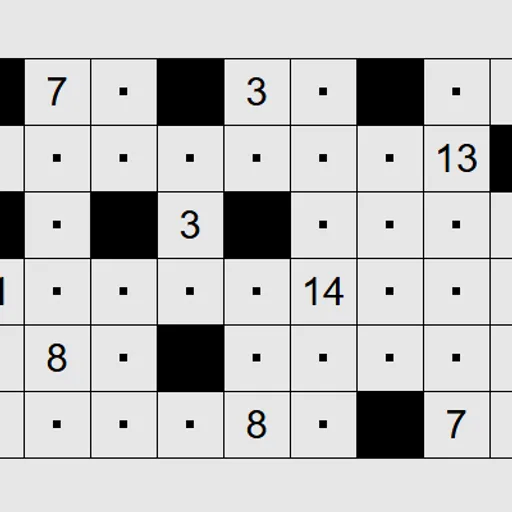
Range Shading Puzzle is a black-and-white grid where every number measures a line of sight. You shade some squares black so each number sees exactly that many white squares, counting itself, looking in four straight directions. The white squares must also stay joined in one region. It is Range, by Jonas Kölker, from Simon Tatham’s Portable Puzzle Collection, also known in Japan as Kurodoko.
What Makes a Solution
Four rules must all hold:
- Numbered squares stay white.
- Black squares never share an edge, though corners may touch.
- All white squares connect through their edges.
- Each number equals the white squares visible from it in its row and column, up to the first black square or edge, including itself.
Left-click to shade, right-click to place a dot that marks a square as surely white. Clicking cycles a square through black, dot and empty. The board flashes when it is correct.
Range Shading Puzzle Controls
| Action | Keyboard | Mouse | Touch |
|---|---|---|---|
| Shade a square black (repeat to cycle) | Arrow keys to move, then Enter | Left-click | Tap with Tap set to Shade black |
| Mark a square with a dot as surely white (repeat to cycle) | Space | Right-click | Press and hold, or set Tap to Dot and tap |
| Dot every square you pass over | Shift + arrow keys | — | — |
| New game, undo, redo | N, U, R | Menu buttons above the grid | Menu buttons above the grid |
Counting and Logic Together
Every clue is a sum of four parts: how far you can see up, down, left and right, plus one. A 5 in the middle of a row might be 2 + 0 + 1 + 1 + 1, or many other splits. The skill is narrowing those splits using the board edges and nearby clues.
The connection rule adds a topology twist. A black square is never allowed to seal off a pocket of white, so near corners and edges some placements are ruled out even if the numbers seem to allow them.
Moves That Crack Boards
- Measure the maximum view. If a number’s whole row and column hold exactly its value, nothing in them can be black.
- Dot around every black square. All four side neighbors must be white.
- Squeeze small clues. A 2 must be blocked on three of its four sides.
- Protect connectivity. Ask whether shading a square would wall off any white area.
- Use Shift with the arrows to lay a trail of dots along a proven white line.
Quick Facts About This Version
Presets range from 9 by 6 to 16 by 11, with custom sizes too. Undo, Redo and Solve are always there, and Preferences can swap the mouse buttons. Small boards suit a ten-minute break. For more grid logic, try Galaxies Symmetry Puzzle or Skyscraper Sightlines, which also counts what you can see.
Tested and updated: