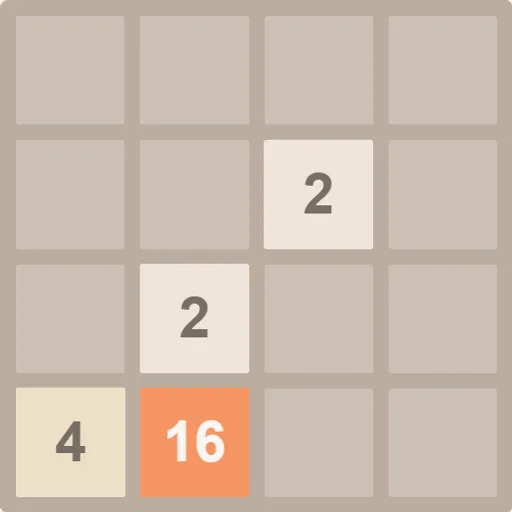
2048 is a sliding-number puzzle where every tile is a power of two and every swipe moves the whole board at once. Two equal tiles that collide fuse into their sum, and your target is a single tile reading 2048. It is worth playing because it rewards planning over luck: a calm, consistent method beats fast random swiping every time.
How a Move Works
You start with two tiles, each a 2 or a 4. Choose a direction and every tile slides until it hits a wall or another tile. Matching neighbors that meet merge into one tile showing their total, and that total goes onto your score. Building a 128 therefore adds 128 points.
Whenever a move changes the board, a new tile drops into a random empty square. It is usually a 2 and sometimes a 4. If a swipe would not shift anything, nothing spawns, so that direction simply does nothing. The run is over once the grid is packed and no pair of neighbors matches.
2048 Controls
| Action | Keyboard | Mouse | Touch |
|---|---|---|---|
| Slide all tiles | Arrow keys, W A S D, or H J K L | — | Swipe up, down, left or right |
| Start a new game | R | Click "New Game" | Tap "New Game" |
| Continue after reaching 2048 | — | Click "Keep going" | Tap "Keep going" |
The Math Hiding in the Tiles
Every value on the board is 2 raised to some power: 2, 4, 8, 16 and so on up to 2048, which is 2 to the 11th. Each merge raises the exponent by one. That means a 2048 tile needs two 1024s, which need four 512s, and so on down the chain. Thinking this way shows why the board gets crowded: to make the next big tile, you need a full ladder of smaller ones lined up and ready.
It is also a lesson in managing limited space. You have sixteen squares, and every turn adds a tile. You only win back room by merging, so every swipe is a small trade between building and tidying.
A Corner Method That Works
- Choose one corner and stay loyal to it. Park your largest tile there, for example the bottom right.
- Use two main directions. With a bottom-right corner, lean on Down and Right. Use Left when you must, and press Up only when nothing else moves.
- Lay out a staircase. Keep the bottom row in falling order away from the corner, like 512, 256, 128, 64. One merge at the small end can then roll all the way to the big tile.
- Keep that row full. A packed edge row cannot slide sideways, so the corner tile cannot be dragged out.
- Deal with stray 2s quickly. A small tile stuck between big ones blocks the staircase. Merge it away before it gets sealed in.
Quick Facts About This Version
Arrow keys, W A S D and H J K L all work on a keyboard, and swiping works on phones. A first win often takes 20 to 40 minutes, so your saved board is handy for breaks. If you like number planning, try Factors Game next, or the sliding logic of Fifteen Slide.
Tested and updated: