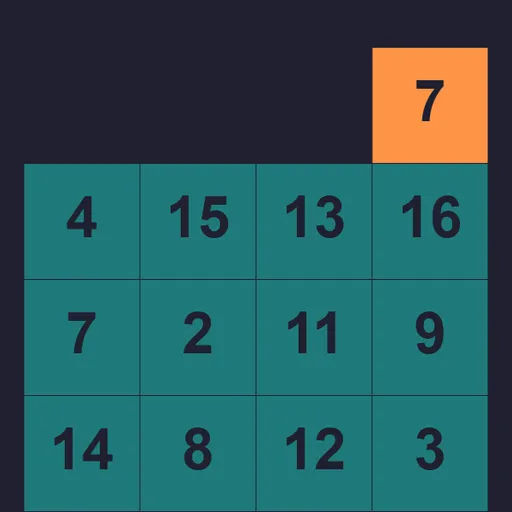
Factors Game turns divisibility into a short route-finding puzzle. You guide one number down a 4x4 grid of tiles numbered 1 to 16, and each tile you land on either divides your number or adds to it. The goal is to finish at exactly 1. It is a quick way to sharpen factor facts, because every move asks the same question: does this tile go evenly into my number?
The Rule That Drives Everything
Your number waits above the board. Slide it into a column, then drop it into the next row. If the tile below is a factor of your number, your number is divided by it. If it is not, the tile’s value is added instead. Holding 15 and landing on 5 leaves 3, but holding 15 and landing on 4 gives 19.
A level has four rows, so you get four drops at most. It ends early if you hit 1. You then see a grade, and finishing any level unlocks the next of the 256.
Factors Game Controls
| Action | Keyboard | Mouse | Touch |
|---|---|---|---|
| Move your number left or right | Left / Right arrows, A / D, or H / L | Drag left or right on the board | Swipe left or right |
| Drop into the row below | Down arrow, S, or J | Drag downward | Swipe down |
| Restart the level (or open level select before your first move) | Up arrow, W, or K | Drag upward | Swipe up |
| Retry or go to the next level after a result | Left to retry, Right for next, Up for level select | Click "< RETRY" or "NEXT >" | Tap "< RETRY" or "NEXT >" |
| Open level select during play | — | Click "[Select]" at the top right | Tap "[Select]" at the top right |
What Factors Game Teaches
This is real number sense practice. To plan well, you need to know divisibility shortcuts without thinking: even numbers split by 2, a digit sum divisible by 3 means 3 works, and numbers ending in 0 or 5 take 5. You also learn that additions are not always bad. Turning 13, a prime, into 16 by adding 3 opens up 2, 4, 8 and 16 as divisors on the rows below.
Prime numbers become the enemy here. A prime can only be divided by 1 and itself, so if you are stuck on 17 with no 17 tile in sight, you have to add your way to something friendlier.
Route Planning Tips
- Read the board from the bottom up. Look at the last row first and ask which numbers it could finish to 1. Then work upward.
- Treat 1 as a pause. Dividing by 1 changes nothing, so a 1 tile lets you skip a row safely.
- Make your number composite. If you hold a prime, add a small tile that turns it into something with many factors.
- Finish with the number itself. Landing on a tile equal to your number divides it to 1 instantly, so hunting for a match on the final row is often the cleanest ending.
- Restart freely. Each level keeps the same layout, so a failed route teaches you the board for the next try.
Practical Notes for Players
The game saves your best run on each level and your overall average in the browser. Swipes and keys both work, and the tall board fits a phone held upright. For more mental math with a clock, try Math Sprint Game, or test factoring under Latin-square rules in Math Cage Grid.
Tested and updated: