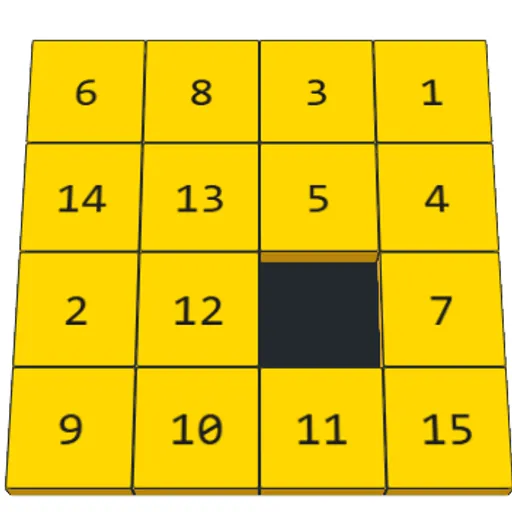
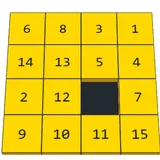
Fifteen Slide is the classic 15 puzzle: fifteen numbered blocks in a 4x4 frame with one empty space. You can only slide a block that touches the gap, so every move shifts the hole somewhere else. The aim is to line the numbers up from 1 to 15, with the gap in the bottom right corner. It is worth playing because it builds step-by-step planning, and solving it with few moves feels earned.
Rules in Brief
Press Play and a 3, 2, 1 countdown runs while the board scrambles. On GO, the timer starts and a move counter appears below the board.
Pick a block next to the gap and it slides in, leaving its old spot empty. One block moves at a time, never diagonally. You finish when the rows read 1 to 4, 5 to 8, 9 to 12 and 13 to 15 with the gap last. A Congratulations screen then asks for a nickname so your moves and time join the High scores list.
Fifteen Slide Controls
| Action | Keyboard | Mouse | Touch |
|---|---|---|---|
| Slide a block into the gap | Arrow keys (the block beside the gap moves in the arrow's direction) | Click a block next to the gap | Tap a block next to the gap |
| Tilt the board in 3D | — | Hold the button and drag across the board | — |
| Start a game or open the scoreboard | — | Click "Play" or "Scores" | Tap "Play" or "Scores" |
| Save a finished result | Type a nickname | Click "Save" | Tap "Save" |
| Return to the menu | — | Click the "Menu" arrow | Tap the "Menu" arrow |
The Math Behind Sliding Puzzles
Mathematicians have studied this puzzle since the 1880s. One famous result is about parity. Each slide swaps the gap with a block, and you can count how many pairs of numbers are out of order. That count, combined with the row of the gap, decides whether a position can be solved at all. Exactly half of all possible arrangements are impossible, which is why this game scrambles with real moves instead of random placement.
You also practice breaking a big problem into smaller ones. You cannot solve all fifteen blocks at once, but you can solve one row and then never touch it again.
A Reliable Plan
- Finish the top row. Place 1, 2, 3 and 4, then leave that row alone.
- Finish the second row with 5 to 8 the same way.
- Handle row-end blocks with a detour. For 4 or 8, park the block below its target, place its neighbor, then cycle both in together.
- Solve the bottom half by columns. Set 9 and 13 together, then 10 and 14, leaving 11, 12 and 15 for a small loop.
- Cycle around 2x2 squares. Moving the gap in a small loop rotates three blocks without disturbing the rest.
Saving, Devices and Play Time
Arrow keys, clicks and taps all work, and the board grows to fit a tall phone screen. A first solve can take ten minutes or more; experienced players finish in a couple. Scores are saved in your browser. For more sliding and merging, try 2048, or step into recursion with Tower of Hanoi.
Tested and updated: