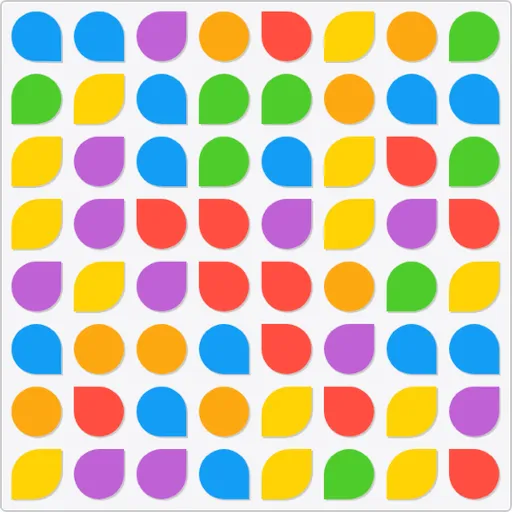
Color Tile Match is a race against a shrinking time bar on an 8x8 grid packed with six colors of rounded tiles. You swap two side-by-side tiles to make a straight line of three or more, and every point you earn buys back a few seconds. It is a fast workout for visual scanning, the skill of spotting a pattern in a busy picture.
Making a swap
Select any tile, then one of the four tiles directly above, below or beside it. If the trade creates a row or column of three or more matching colors, those tiles clear. Tiles above fall into the gap and new ones drop in from the top, which can set off extra matches for free. A swap that forms nothing slides back.
The round stops when the bar empties or no legal swap is left. Stay idle for about 15 seconds and the game hints at a move.
Color Tile Match Controls
| Action | Mouse | Touch |
|---|---|---|
| Swap two tiles | Click a tile, then click a neighbor, or drag a tile onto a neighbor | Tap a tile, then tap a neighbor, or slide a tile onto a neighbor |
| Highlight a possible move | Click the magnifier button | Tap the magnifier button |
| Use a booster on the selected tile | Select a tile, then click the brush, bomb or palette button | Select a tile, then tap the brush, bomb or palette button |
| Start a new game | Click the circular arrow button | Tap the circular arrow button |
| Read the rules (pauses the timer) | Click "FAQ" | Tap "FAQ" |
The numbers in a match
Each line scores its length squared. Three tiles give 9 points, four give 16 and five give 25. So one line of five is worth nearly three lines of three, and because points refill the clock, it also buys almost three times the time.
That square rule turns the game into a quick estimation task. When you see two possible swaps, you weigh which one makes the longer line or is likely to trigger a cascade.
Ways to score more
- Make matches low on the board. Everything above shifts, and falling tiles often line up by themselves.
- Scan for “two plus one” shapes: a pair with a matching tile one step off the line. Those are your swaps.
- Look at the color counter strip under the board, then use the brush on the most common color.
- Save the bomb for a cramped area with no moves. It clears the chosen tile and every tile around it.
- Place the wild palette tile between two nearly finished lines so it completes both.
- Keep an eye on the magnifier count. A low number warns you that the board is close to a dead end.
Things Worth Knowing First
Your best score is kept in your browser, and a language button switches between English and Russian. A full round runs only a few minutes. If you prefer a calmer pace with no clock, try Same Game Blocks, or move on to the rotating board in Hextris.
Tested and updated: