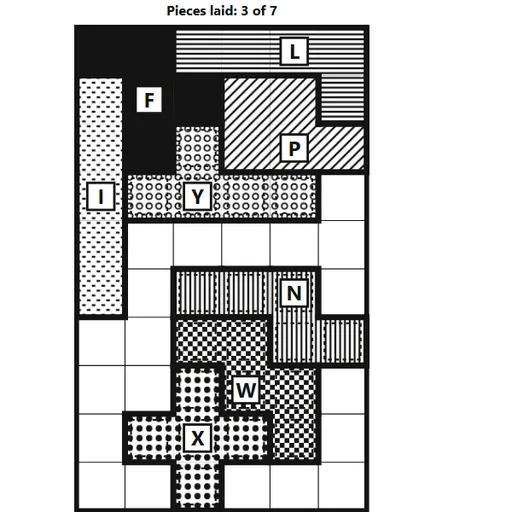
Five-Square Tiling Puzzle asks you to fill a rectangle with flat pieces, each made of five squares joined along their edges. There are twelve such shapes, often called pentominoes, and each is named after the letter it looks like. The puzzle is from Christopher Müller’s open-source PaperGames collection. It is worth playing because it trains spatial planning: the last two pieces only fit if you thought ahead.
How a Puzzle Works
Choose a piece from the tray under the board. It appears next to Turn and Flip, with a small dot on one of its squares. Rotate or mirror it, then tap the board square where the dot should go. Tap a laid piece to lift it back.
The goal is to cover every square exactly once. In Free laying, any filling counts. Easy and Medium give you fixed piece sets, while Hard hands you all twelve on a field size you choose. In Start pieces given, some pieces are locked onto a 6 by 10 board, and you place three, five or seven more into the only arrangement that works.
Five-Square Tiling Puzzle Controls
| Action | Keyboard | Mouse | Touch |
|---|---|---|---|
| Choose a piece | Tab to the piece in the tray, then Enter | Click the piece below the board | Tap the piece below the board |
| Turn or flip the chosen piece | Tab to "Turn" or "Flip", then Enter | Click "Turn" or "Flip" | Tap "Turn" or "Flip" |
| Lay the piece | Tab to the square where the piece's dot should go, then Enter | Click the square where the piece's dot should go | Tap the square where the piece's dot should go |
| Lift a laid piece | — | Click the piece on the board | Tap the piece on the board |
| Ask for help | — | Click "Hint" | Tap "Hint" |
The Math of Tiling
Twelve pieces of five squares cover 60 squares, which is why the full set fits 6 by 10, 5 by 12, 4 by 15 and 3 by 20. All four have an area of 60. The narrow 3 by 20 board has only two solutions, while 6 by 10 has thousands, so the same pieces can make a very easy or very tight puzzle.
Area also gives you a quick check. Any closed-off empty space must be a multiple of five squares, or it can never be filled.
Fitting Advice
- Work from the edges. I, L and U have long straight sides that hug the border.
- Place the X early. The cross needs open space on all four sides of its center.
- Count trapped gaps. If a pocket holds 7 or 8 squares, fix it now.
- Flip asymmetric pieces. F, N, P, Y, Z, L and similar shapes change when mirrored.
- Use Hint to test a theory. It also warns you when a laid piece blocks every solution.
Things Worth Knowing First
Easy boards take a few minutes, and Hard fields can take much longer. Pieces carry letters and patterns, so you do not need color to tell them apart. Keyboard users can Tab through every control. For more shape work, try Tangram or the sliding blocks of Fifteen Slide.
Tested and updated: