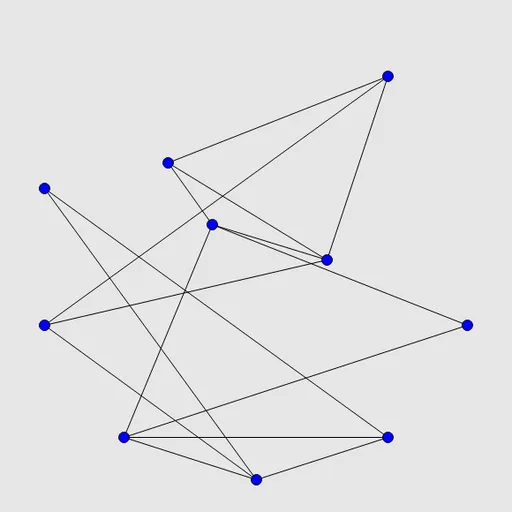
Untangle Lines shows a set of points joined by straight lines, arranged so the lines cross all over the board. You can drag any point anywhere, and its lines stretch along with it. Your goal is to move the points until no two lines cross. It is Untangle from Simon Tatham’s Portable Puzzle Collection, and its calm pace makes it a relaxing way to think about shapes and networks.
How to Play
Every new puzzle places the points evenly around a circle, so the lines cut through the middle in a messy web. Press on a point and drag it to a new spot. The links between points never change, only their positions.
When no line crosses any other, the board flashes. There is no timer and no move limit, so you can experiment freely.
Untangle Lines Controls
| Action | Keyboard | Mouse | Touch |
|---|---|---|---|
| Move a point | — | Click and drag the point | Drag the point with your finger |
| Pick and move a point by keyboard | Arrow keys or Tab/Space to choose a point, Enter to pick it up, arrows to move, Enter to drop | — | — |
| Undo, redo, new puzzle | U / R / N | Undo move, Redo move and New game buttons | Undo move, Redo move and New game buttons |
| Change the number of points | — | Type menu | Type menu |
The Math of Flat Drawings
In math, a set of points joined by lines is a graph. A graph that can be drawn with no crossing lines is called planar, and every puzzle here is planar by design. Untangling is really finding a planar drawing of a graph you were handed in a messy form.
A neat fact helps: in any planar drawing, the lines divide the board into regions called faces. Triangles of mutually linked points often form the faces, so finding them gives you a skeleton to build around.
How to Approach It
- Find a triangle. Three points all joined to each other make a solid frame. Spread them out.
- Place low-link points first. Points with only two or three lines are easier to tuck inside a face.
- Drag busy points last. A point with many lines usually belongs near the middle of its neighbors.
- Use the whole board. The circle only fills part of the space, so move solved areas outward.
- Turn on crossing highlights to see exactly which lines still need work.
Quick Facts About This Version
A 10-point puzzle takes a few minutes, while 25 points can take much longer. Touch dragging works with one finger, and keyboard users can pick up and move points with Enter and the arrows. For another graph puzzle, try Bridges Island Puzzle. For shape fitting, try Tangram.
Tested and updated: