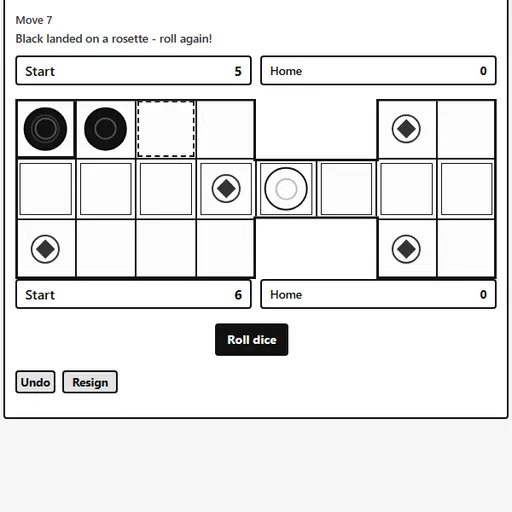
The Royal Game of Ur is a race game from ancient Mesopotamia, known from beautiful boards found in royal tombs. Each player rolls four two-sided dice and moves seven pieces along a winding 14-square path, hoping to bring all of them home first. It is a fine game for thinking about probability, since the dice favor some numbers far more than others. This version from the PaperGames collection follows a modern reconstruction of the rules and offers a computer with three levels or a two-player mode.
Moving along the path
Your pieces start in a Start tray. Press Roll dice and count the marked faces: that is your move, from 0 to 4. Then move one piece forward that many squares, either one on the board or a new one from Start. Highlighted pieces show your legal choices.
The first four and last two squares of your path are private. The eight squares in the middle row are shared. Land on an enemy piece there and it goes back to its Start. Land on a rosette, shown with a diamond, and you roll again. A piece leaves the board only with an exact roll, and the first player to bring all seven home wins.
Royal Game of Ur Controls
| Action | Keyboard | Mouse | Touch |
|---|---|---|---|
| Roll the dice | Tab to "Roll dice" and press Enter | Click "Roll dice" | Tap "Roll dice" |
| Move a piece | Tab or arrow keys to a highlighted piece or the Start slot, then Enter | Click a highlighted piece, or the highlighted Start slot to enter a new piece | Tap a highlighted piece or the highlighted Start slot |
| Choose color and opponent | — | Pick black or white and a level, then click "New game" | Pick black or white and a level, then tap "New game" |
| Undo or resign | — | Click "Undo" or "Resign" | Tap "Undo" or "Resign" |
The math of four coins
Each die is like a coin flip, so four dice give 16 equally likely results. Only one result gives 0 and only one gives 4, while six results give 2. This bell-shaped spread means an enemy two squares behind you is the biggest danger, and a piece four squares from a rosette rarely gets there in one roll.
Smart choices
- Claim the middle rosette. A piece parked on it is safe and stops your opponent from landing there.
- Measure danger by distance. Enemy pieces one to three squares behind are the threats, with two squares the worst.
- Use small rolls to enter. A 1 is often best spent bringing a new piece onto your private squares.
- Keep pieces waiting. Pieces just before the shared lane can strike enemies that pass in front.
- Stagger your exits. Pieces at different distances from home make more rolls useful.
Setup and Device Notes
Hard also estimates how likely each exposed piece is to be hit next turn. The game saves between visits, and Undo and Resign are always available. If you like ancient games, play Senet next, or try Backgammon, a later race game with similar ideas.
Tested and updated: