Dominoes is a matching game played with the 28 tiles of a double-six set, where each tile carries two numbers and the line grows from both ends. You win the round by placing your last tile before anyone else. Under the simple rule sits a neat counting puzzle, because every number appears on exactly seven tiles, and keeping track of them tells you what your rivals can and cannot play. You can fill up to three seats with computer players or pass one device around the table.
The flow of a round
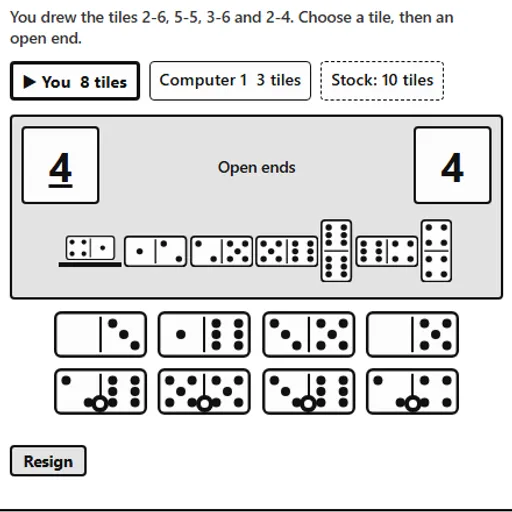
Tiles are shuffled and dealt, and the player holding the highest double sets it down first. If nobody has a double, the heaviest tile opens. After that, each turn you add one tile to either open end. The half that touches the line must show the same number as that end, so placing a 5-3 on an open 5 leaves a 3 showing.
No match in your hand means you draw from the stock until you find one. If the stock runs out and you still cannot play, you pass. The round stops when someone goes out or when everyone is stuck.
Dominoes Controls
| Action | Mouse | Touch |
|---|---|---|
| Play a tile | Click a tile in your hand, then the open end it should go on | Tap a tile in your hand, then the open end |
| Draw from the stock | Click "Draw from stock" when nothing fits | Tap "Draw from stock" when nothing fits |
| Pass your turn | Click "Pass" once the stock is empty | Tap "Pass" once the stock is empty |
| Show your hand in a shared-device game | Click "Show my tiles" | Tap "Show my tiles" |
| Set up a new round | Choose mode, players, variant and level, then click "New game" | Choose mode, players, variant and level, then tap "New game" |
Counting is the real skill
Picture the seven 4s: 4-0, 4-1, 4-2, 4-3, 4-4, 4-5 and 4-6. If five of them are already on the table and you hold the sixth, there is only one 4 left anywhere. An end showing 4 is then nearly dead for your opponents. Tracking numbers like this is simple addition and memory, and it is what separates careful players from lucky ones.
Smart habits at the table
- Play doubles before they trap you. A double only matches one number, so it gets stuck easily.
- Get rid of high tiles such as 6-6 or 6-5 early, since leftover pips count against you if the line blocks.
- Hold a mix of numbers so you can answer almost any end.
- Notice when a rival draws. Someone who drew against an open 2 probably has no 2s, so leaving 2s showing can stall them.
Before you play
Each round is a single hand with no running score, so a game takes only a few minutes. In same-device mode, every hand stays hidden behind a “Show my tiles” button. The round in progress survives a page reload. For another quick family game, try Snakes and Ladders or the pencil-and-paper classic Dots and Boxes.
Tested and updated: