
Dots and Boxes is the pencil-and-paper game of joining dots to close squares. Each completed box is yours, and finishing one gives you another line right away. It looks like a game of luck, but it is really a logic and counting puzzle: the player who understands chains can give away a few boxes early and still win by a wide margin. This version from the PaperGames collection offers four grid sizes and a computer at three levels.
Playing a game
Choose a grid of 4x4, 5x5, 6x6 or 8x8 boxes. Player 1 draws first. On each turn you draw one line between two dots that sit side by side, across or up and down.
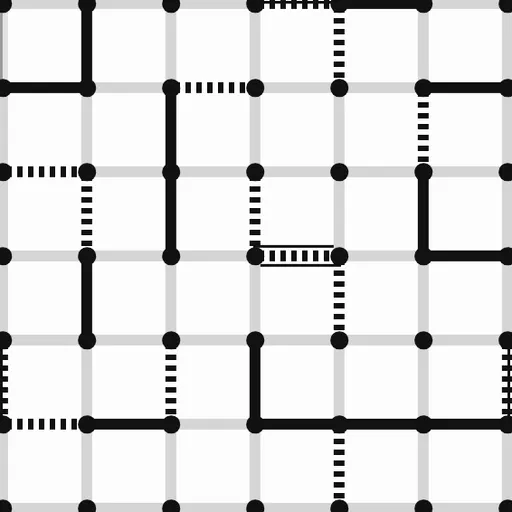
Draw the fourth side of a box and it is yours, marked with a cross for Player 1 or a circle for Player 2. You then draw again. Your turn only ends when your line closes nothing. When every line is drawn, the player with more boxes wins.
Dots and Boxes Controls
| Action | Keyboard | Mouse | Touch |
|---|---|---|---|
| Draw a line | Arrow keys to reach a line, Enter to draw it | Click the gap between two neighboring dots | Tap the gap between two neighboring dots |
| Start a game against the computer | — | Click "vs Computer", pick Player 1 or 2, a level and a grid size, then click "New game" | Tap "vs Computer", pick Player 1 or 2, a level and a grid size, then tap "New game" |
| Play a friend on one screen | — | Click "2 Player (local)" | Tap "2 Player (local)" |
| Take back a move | — | Click "Undo" | Tap "Undo" |
| Open settings | — | Click "Settings" | Tap "Settings" |
The logic behind chains
Count the sides of each box. A box with three sides is a free gift to whoever moves next. Early on, both players draw safe lines that keep every box at two sides or fewer. Eventually no safe lines remain, and the board breaks into chains of linked boxes. Now it is a counting game: how many chains, and how long is each one? That count decides who must open the first chain.
Strategy in order
- Never draw a third side early. It hands your opponent a box and an extra move.
- Play safe lines as long as possible. Make the other player run out first.
- Open the shortest chain. When you must give something away, give the least.
- Learn the double-cross. When taking a long chain, leave the last two boxes with one line. Your opponent takes those two but must then open the next chain for you.
- Count chains on big grids. The 8x8 game is usually decided by who controls the last long chains.
Things Worth Knowing First
Player 1 uses solid lines and Player 2 dotted lines, and a legend sits under the grid. Undo steps back through moves, and your game is saved in the browser. For more counting and planning, try Mancala, or the territory game Game of the Amazons.
Tested and updated: