Coding Golf is a full 18-hole golf game viewed from straight above. A golfer named Fred sneaks onto the island course where he works to play a round and chase the Broken Links trophy. You pick clubs, read the wind and time a classic three-press swing meter. Coding Golf turns distance, angle and wind into a running math problem, one shot at a time. Jasper Renow-Clarke made it for the js13k contest in 2020.
Playing a hole
Each hole is a twisting green fairway surrounded by dark blue sea, from a red tee to a flag on a lighter green. A panel in the top left lists the distance in yards, your stroke, the par and your club. Par runs from 3 to 6 depending on length.
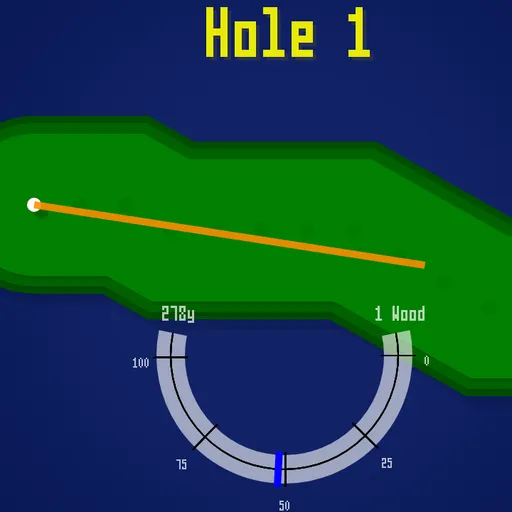
An orange line shows your aim and how far the chosen club carries. There are 19 clubs, from a 1 Wood that carries 278 yards down to a putter that rolls 10. Turn with the arrow keys or the mouse wheel and switch clubs with Up and Down.
Then swing in three presses: start, power, accuracy. Running the needle past 100 makes the game set power for you, with a random sideways error. Sea costs a stroke and returns you to your last spot. Sand stops the ball, and bunker shots lose power and drift. The ball drops once it rests within about 2 yards of the cup.
Coding Golf Controls
| Action | Keyboard | Mouse |
|---|---|---|
| Start a round, close the scorecard | Space or Enter | Click |
| Turn your aim left or right | Left and Right arrows | Scroll wheel |
| Change club | Up and Down arrows | — |
| Start the swing, set power, set accuracy | Space or Enter (three presses) | Click three times |
| Show the scorecard | S | — |
The math of a good shot
Every swing is an estimate. You compare the distance left with each club’s carry, then adjust for the wind arrow and its mph number. A headwind shortens the shot, a tailwind lengthens it, and a crosswind pushes it sideways. Choosing a club is really a quick subtraction and comparison.
Power adds proportion. A club at 80 percent power carries less than its full distance, so a long club hit softly and a short club hit hard can land in the same place.
Course strategy
- Check the wind panel before every shot. It changes each time.
- Do not overswing. Stopping near 100 is fine, going past it is not.
- Switch to wedges early near the green. They carry 30 to 115 yards.
- Play the bends of the fairway instead of cutting across water.
- Watch for bunkers in front of greens, since sand shots can wander up to 10 degrees.
- Press S to see the scorecard and how you stand against par.
Before You Press Play
There is no music on this version of the game. Each hole shows a result such as Birdie or Bogey, and the card splits into Out and Home nines. For a smaller putting course, try Mini Putt Park. For golf with planets instead of sand, see Gravity Golf.
Tested and updated: